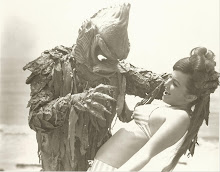
I'll be reviewing the Blu-ray release of Island Claws for an upcoming issue of SCREEM magazine, a piece that will include comments from two of the film's stars. In advance of that, I thought I'd share a few images from the film's various marketing campaigns that I stumbled across.
First up is the VHS cover art, which was re-used for the new Scorpion Blu-ray.
Then there's this poster image, which appears to be for the overseas, Spanish-language video release.
And finally, this mysterious image that I found in a chat room that may have been from some pre-release promotional material, sporting a completely different title.
My Island Claws coverage will be in the spring issue of SCREEM.
With all of the new titles either returning on Blu-ray or debuting on DVD in the next few months, does it reflect poorly on me that the one I'm most excited about is a limited pressing of the loopy giant crab flick Island Claws?
You can see the cover here. The only extra on the disc will be an on-camera interview with Ricou Browning, the Creature From the Black Lagoon stuntman who worked on the film. As we previously posted, Island Claws may have been an elaborate money laundering project for associates of the Medellin drug cartel. It was once a staple on cable TV, but has been unavailable on legit home media since it was released on VHS in the 1980s.
Scorpion and Kino Lorber also re-released the Georgia-lensed William Girdler film Grizzly, which is now on sale at Amazon (it's cheap, too).
For the city of Miami, the run-down shacks that litter the property around Jimbo's, a former shrimping operation on Virginia Key, are an eyesore in need of razing; for Jimbo's patrons, they're just part of the increasingly shoddy scenery around the bait shack, where generations of South Florida residents have gathered for Jimbo's weekly smoked fish and beer parties. But for low-budget horror film fans, those shacks are the last remnants of one of the strangest chapters in Florida filmmaking history -- and since we're talking about the state that gave us Blood Feast (1963) and Nude on the Moon (1961), that's saying something.
Island Claws has always gotten a bad rap, in my opinion. Made at the tail end of the second wave of giant bug/monster movies that emerged somewhat anachronistically in the 1970s, Claws lacked the star power of Kingdom of the Spiders or Empire of the Ants, and didn't have nearly the level of manic silliness found in, say, The Giant Spider Invasion or Food of the Gods. As such, it's been relegated to the shadows -- which is a shame, since not only does the film boast an impressive (for this type of film) giant crab (built by Oscar-winning special effects veteran Glen Robinson), along with decent performances by Robert Lansing and Barry Nelson, and a script co-written by Creature from the Black Lagoon star Ricou Browning, it also has one of the most fascinating back-stories of any of its contemporaries.
The film began production in the summer of 1980, and Cardenas Productions immediately made a splash by constructing an entire fishing village on Virginia Key (hence, the shacks at Jimbo's) and putting out a call for residents to help the filmmakers round up 2,000 land crabs to augment the "star" of the show -- a 9,000-pound mechanical crab.
"We have high hopes that this will be the first blockbuster movie made here," said Mary Lee Lander, director of the Dade County Office of Film and Television Coordination, in a Miami News Reporter article. She had reason to be hopeful; unlike other Florida horror films, this one boasted a substantial budget: $3.5 million, most of it coming from the film's principal financers, Dario and Hernan Cardenas.
Which is where the story gets interesting. Hernan Cardenas (credited as the film's director), later described as a "Colombian abstract expressionist painter," came up with the film's concept while bicycling with his wife. As for financing, a Dec. 3, 1987, article in The Lakeland Ledger posits the budget may have originated from the Cardenas' brothers other business -- cocaine.
According to the Ledger article, Hernan and Dario had a another brother, Gabriel, who also happened to be the brother-in-law of Medellin Cartel boss Jorge Ochoa. Although Gabriel had been nabbed in a cocaine bust years earlier, the Ledger article makes the case that Island Claws may have been an elaborate and expensive money laundering "investment."
The Cardenas brothers certainly didn't skimp on the production. In addition to hiring Robinson to build the monster crab, they brought on veteran Florida producer Ted Swanson (who had worked on Rocky and Caddyshack). A July 8, 1980, article in the Miami News also noted that Jimmy Pergola, Ron Sinclair and David Whorf would "direct and edit" the picture.
Pergola is a cinematographer whose credits range from Dillinger (1973) to Major League (1989) to "Baywatch." Editor Sinclair had worked with both Roger Corman and William Grefe. Whorf was an experienced second-unit director who had worked in both film and TV. It's possible that Whorf either directed the film uncredited, or was at some point actually replaced by Cardenas.
The $500,000 crab itself sounds more impressive than it wound up looking. From that same Miami News article:
"The crab will be powered by a bulldozer, along with separate Honda and Volkswagen automobile engines. The legs and claws will be moved by a massive hydraulic system connected to a computer. An 800-pound fluid tank will provide the blood-like juices. A four-camera closed-circuit system will be its eyes."
From what I can gather, the film did not have a theatrical release, and later turned up on TV as Night of the Claw. It was also a staple (under its original title) of late-night TV and was released on video by Vestron.
It's been out of print ever since. According to the old video box, the film's copyright is held by "Hernan Cardenas, Colby Cardenas, his wife and Producciones Cardenas Inc."
Swanson passed away last year. I haven't been able to determine if any of the Cardenas brothers still live in the U.S. Island Claws remains sadly unavailable on legit DVD.
The Dead Next Door is a blog about regional or "backyard" horror and science fiction films made from the late 1950s to the earlyl 1990s (and beyond). These films were released during the peak years of independent film production, created by a motley crew of seasoned pros, gifted amateurs, and enthusiastic genre fans, along with dozens of eccentric dreamers -- doctors, lawyers, insurance salesmen, publishers, commercial filmmakers, TV production crews and moonlighting pornographers -- all looking for their big break or a fast buck or both.