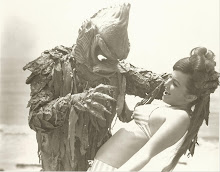
Fred Olen Ray has dug into his vault and made another 50 or so copies of his RetroMedia Beast Collection DVD set available on Amazon (get 'em while you can). The set is a cornucopia of regional horror flicks, including Ed Adlum's Shriek of the Mutilated, Bill Rebane's Capture of Bigfoot, Sasquatch: The Legend of Bigfoot, Larry Buchanan's The Eye Creatures, and the subject of our trailer of the week, Zontar: The Thing From Venus. Since Zontar was originally a made for TV project, we've posted a series of homemade trailers below that range from sublime to ridiculous.
This summer will mark the 50th anniversary of H.G. Lewis' groundbreaking gore film Blood Feast. I'll be posting a number of trade press items about the film from that period over the next few months, leading up to the "official" anniversary date in July. In the meantime, I thought I'd post some other items related to regional horror film production in 1963 as well.
It was that year, for example, that a number of tax incentives went into effect that helped spur independent film production in general (and regional film production specifically), and you can see a steady increase in indie film output from that year forward until the tax breaks were eliminated in the 1980s. 1963 also marked the debut of key early works from the likes of Larry Buchanan, William Grefe, Bill Rebane, and other regional horror stalwarts.
Below I've gathered a few items from BoxOffice magazine's May 1963 issues that are related to some of those filmmakers. To put things in context, in 1963 Hollywood was facing declining attendance numbers as television gained a greater foothold in American households. Films deemed too violent or racy were still subject to bans from local censor boards and attacks from women's groups and the Catholic Legion of Decency. Many theaters (particularly in the South) were still segregated. Blood Feast arrived at a time when the American horror market was dominated by low-rent Psycho knock-offs and Roger Corman's Poe series, but far from Hollywood a new group of filmmakers was starting to emerge that would take the genre in new, and often exceedingly odd, directions.
Invasion of the What?
The May 13, 1963 edition of BoxOffice included this nugget, which refers to two early Del Tenney features (Invasion of the Zombies was actually the working title of Horror of Party Beach). The same issue indicated that Tenney's partner, Alan Iselin, was expanding his theater chain, snapping up drive-ins in Florida and New York.
New Company Turns Out Two Horror Attractions
NEW YORK -- A new company, Iseling-Tenny Productions, has been in existence about four months and has turned out two feature films, "The Curse of the Living Corpse" and "Invasion of the Zombies" at Stamford, Conn.
The company is headed by Alan V. Iselin, an upstate New York and Florida theatre owner, and Del Tenney, a former stage and television actor, who serves as producer-director.
Complete merchandising manuals rather than the usual press books will be prepared for each picture and combination, Iselin said.
Ted Spiegel, former advertising-publicity director for Kingsley International Pictures and for Union Film Distributors, has been named vice-president in charge of advertising, publicity and merchandising for the new company.
Approximately two pictures a year are planned by Iselin and Tenney. In preparation are "Airlines Stewardesses" and "Ski Weekend."
Larry Buchanan Makes a Splash
1963 was the year of PT 109, Cleopatra, Bye Bye Birdie, The Great Escape, The Birds, How the West Was Won, and From Russia With Love. But one of the films nabbing BoxOffice headlines (and raking in a lot of cash) was Larry Buchanan's controversial Free, White and 21. The film, distributed by American International Pictures, was a courtroom drama (based on a true story) about a black man accused of raping a white woman, and was successful enough to establish an ongoing relationship between Buchanan and AIP that eventually resulted in the production of a slough of cheap made-for-TV monster movies.
A key part of the promotion of the film involved providing paper ballots to audience members so that they could serve as an ad hoc jury. Part of the film's ad campaign in Boston included call-in voting. The number in the Boston advertisements led to an answering service that was soon swamped with calls. According to BoxOffice May 20 issue:
"So great was the curiosity that the Copley exchagne in downtown Boston was inoperative due to the preponderance of the calls. At one time the load was so great that the telephone company had to change the downtown office exchange to a 'Devonshire' number. "A count revealed 5,572 calls on one day, a record for such a device ... the machines broke down twice and had to be repaired due to the curiosity aroused by the subway posters and billboard posters."
A Romantic Adventure
BoxOffice June 3, 1963 Flamingo Productions Has First Picture Under Way MIAMI -- A new motion picture company has been formed here under the name of "Flamingo Productions, Inc.," with Irwin and Herb Myers as producers. The two brothers have been in the construction and real estate development business here. "Miami Rendevous," a romantic adventure, will be their first picture, and shooting has started on locations in Miami and Miami Beach. It will be a full-length feature in color, with Hal Carrington as camerman. Gloria Izzo is handling coordination and casting and the lead roles will be announced soon. An all-Miami cast is being assembled.
As far as I can tell, this film was released as Passion Holiday, and featured Christy Foushee (a.k.a. Blood Feast's Toni Calvert), Linda Hall, Yanka Mann (who appeared in several Florida-lensed horror films), and Stella Palma in the cast.
Also in the news on June 3:
Producer-director Bill Rebane, with a revised script, is trying to get police cooperation from superintendent O.W. Wilson in shooting Loop scenes for his sciece fiction movie, "Terror at Half Day." Hollywood producer Doc Stanford is Rebane's new partner.
The June 3, 1963 issue also lists Carnival of Souls as a current release from Herts-Lion International, even though that film was already a year old at the time.
Welcome to "The Dead Next Door", a blog dedicated regional horror and science fiction films from the 1950s through the 1990s (and maybe beyond, if I feel like it). Each week, I'll be posting information on obscure regional horror flicks, profiles of the men and women who made them, news on upcoming DVD releases, and various flotsam, jetsam and various bits of ephemera related this particular back alley of genre filmmaking.
But first, just what the heck is a regional horror film? One of the goals of this blog is to, hopefully, better define the boundaries of the backyard film, but for my purposes I'd say a regional horror film is one that was 1) produced independently; 2) was filmed outside of the immediate vicinity of Los Angeles; and 3) was made with a cast and crew consisting primarily of residents of the state in which the film was shot.
That's a fairly broad definition that covers everything from Night of the Living Dead (1968), The Texas Chain Saw Massacre (1974), Blood Feast (1963), and The Last House on the Left (1972), to Manos: The Hands of Fate (1966), Don't Look in the Basement (1973), Scarecrows (1988), Invasion of the Blood Farmers (1972) and Woodchipper Massacre (1988).
But just what does "independent" mean in this context? For the most part, anything shot without the support of an established studio or distributor, but I'd also include films that were made by companies that were smaller than AIP, provided they were headquartered outside of California.
So John Russo's Midnight (1982), which was made in Pennsylvania by an established production/distribution company (Independent-International Pictures) would qualify, but Sugar Hill (1974), which was made in Texas by American International Pictures with a cast and crew that hailed mainly from Hollywood, would not. Friday the 13th (1980), which was made independently in New Jersey before being picked up by Paramount, is a regional film; Squirm (1976), which was made by New York filmmakers in Georgia with backing from AIP, is not. Or is it?
There are a few films that I think of as regional productions that actually fall into a kind of gray area. AIP handed some money and a few actors to William Girdler for the unforgettable Exorcist knock-off Abby (1974), but that film looks a lot more like his homegrown Louisville productions than his later, studio-backed films. AIP similarly used Larry Buchanan's crew when it outsourced production of its cheap, made-for-TV horror films (The Eye Creatures, Zontar, etc.) to the Texas filmmaker.
Other films have even more convoluted pedigrees. The same New Jersey production team that brought us the Ginger series went all the way to New Mexico to make Track of the Moonbeast (1976), and New Yorker Robert Allen Schnitzer made The Premonition (1976) in Mississippi.
And there dozens of other strange geographical permutations of this phenomena of the regional horror film, too many to cover in this one post. I hope that, over time and with the help of whoever might wander over to read my musings, I can get a better handle on exactly what is and isn't a regional horror film, while sharing as much information as I can dig up about these often obscure pieces of backwood celluloid.
And what a collection of films we have to dissect! There have been thousands of books written about the horror film over the years, and they've been organized almost every way imaginable: chronologically, by subgenre, by studio, by director, by subject matter, by country of origin, and even by the amount of gore spilled per film, but you will find no other collection of films so odd and vast and varied as when you arrange U.S.-made fright flicks geographically. Some of the most influential horror films of the last four decades were regional productions, along with some of the most excruciatingly awful ones. A number of these films are beautifully shot masterworks; others are so cheap and handmade that they almost qualify as folk art. Suffice it to say that no matter where they were filmed or who made them, they are uniformly fascinating, peculiar, charming and almost never boring.
Okay, some of them are pretty boring. I promise not to dwell too long on those ones.
Finally, why "The Dead Next Door"? I actually stole the title from an Akron-lensed zombie flick made by J.R. Bookwalter, my former editor and a prolific producer/director who was previously and now is once again based in Ohio. I always liked the title, and thought it summed up the spirit of these films quite nicely. For the record, I asked J.R. before I copped the title. Also for the record, he stole the title from a Billy Idol song.
Until next time, here are a few snippets from some of my favorite regional monstrosities:
The Dead Next Door is a blog about regional or "backyard" horror and science fiction films made from the late 1950s to the earlyl 1990s (and beyond). These films were released during the peak years of independent film production, created by a motley crew of seasoned pros, gifted amateurs, and enthusiastic genre fans, along with dozens of eccentric dreamers -- doctors, lawyers, insurance salesmen, publishers, commercial filmmakers, TV production crews and moonlighting pornographers -- all looking for their big break or a fast buck or both.