Showing posts with label Mississippi. Show all posts

Friday, February 8, 2013

Revenge of the Creeping Unknowns


By far, the most popular post I've ever written for this blog was the Creeping Unknowns list of rare and lost regional horror films. Since those original posts (here and here), a handful of the films have turned up for either legit DVD releases or at least a screening or two.

In the meantime, tips from readers and my own research have led me to a few more obscure treasures. A couple of these are fairly easy to see, although most people have never heard of them, and a few are truly MIA.

As always, if you have any additional information or images related to these films, feel free to pass them along!

-->
Southern Shockers (1985): I've written extensively about this Mississippi shot-on-video anthology, which was only released on tape in Spain. It's since gotten some press in Tape Mold, and there is still hope that producer David Hopper can pull together the English-language elements so someone other than this writer can watch it. 


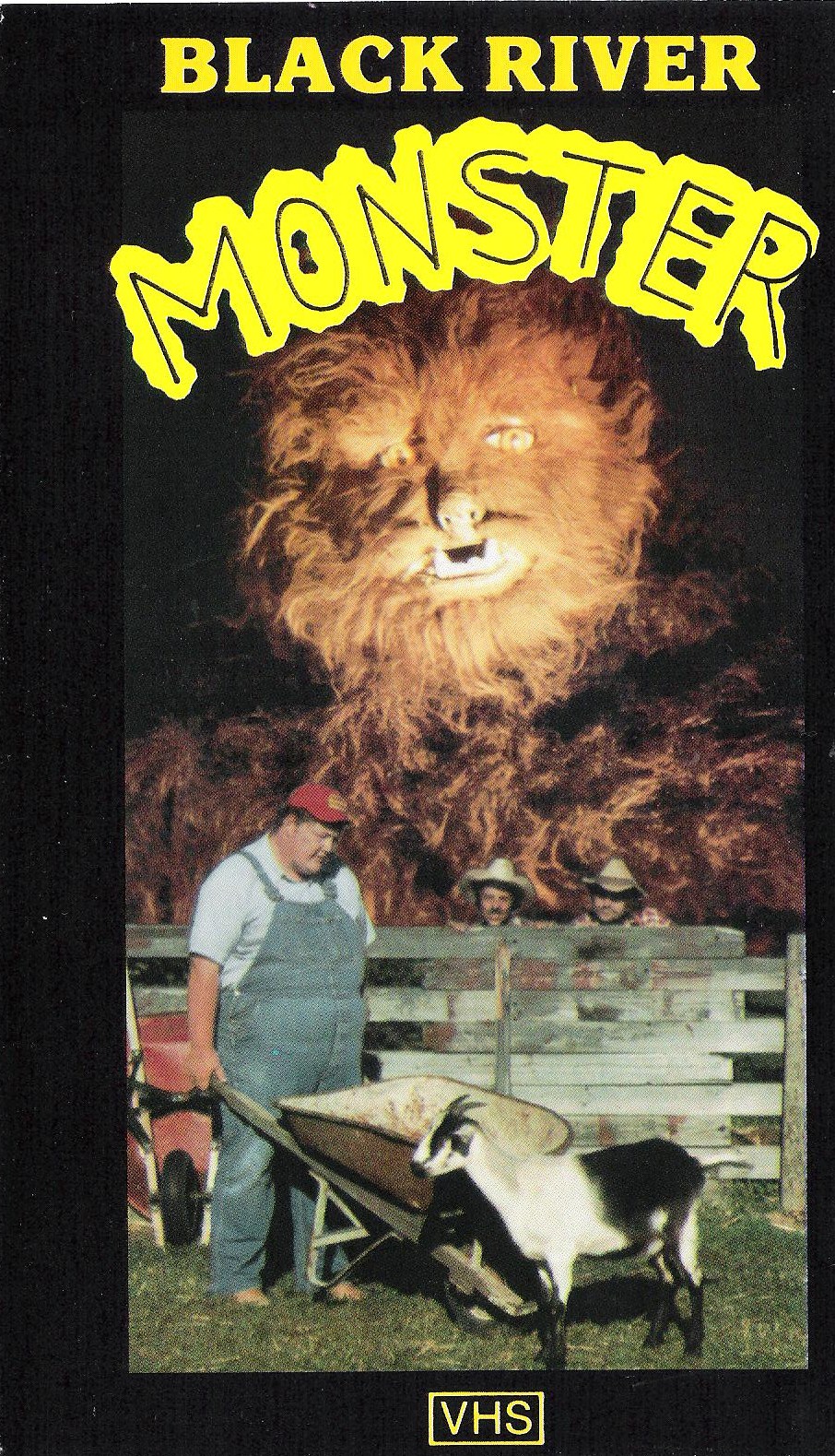
The Black River Monster (1986): We discussed The Hackers (1988) in the last "Creeping Unknowns" post, even though the film had, by that point, been released onDVD by original production company Camelot Studios. We were so excited about that DVD that we completely overlooked the company's other horror DVD, The Black River Monster. This one was made at the Black River Farm and Ranch (a local summer camp), and features a bigfoot-style creature. It's part kiddie flick, part promotional film, and all weird. 


Satan Place: A Soap Opera From Hell (1990): Directed by comic book artist Alfred Ramirez (who also published a comic of the same name), this cheapo, Florida-lensed anthology hasn't completely slipped through the cracks. As I noted in previous posts, Joe Bob Briggs reviewed it, and it has turned up on some torrent sites. Still, this one remains unknown to most fans. 
Blood of the Wolf Girl (1989): When director Harry Preston (Harry Pimm) passed away in 2009, his only horror credit as far as most regional horror fans were concerned was the goofy Texas slasher film Honeymoon Horror (1982). But he made one other fright flick, the unreleased Blood of the Wolf Girl (1989) about a stripper who transforms into a werewolf, which he would occasionally screen for friends and visitors. 

Road Meat (1987): Shot in Ohio by Bill Bragg, this features an early credit by director Jay Woelfel (Beyond Dream's Door) as director of photography. And that's about all I know of it. Copies of the apparently unfinished film do allegedly exist. (Thanks to Adam Jeffers at Trashnite.com for bringing this one to our attention.)

The Men in Black (1990): Another lost Ohio film, this one shot in Columbus and Sandusky. OSU grad Bradley Lee directed the 16mm film (Walt Burbach produced), which is about MIBs trying to intimidate a UFO witness. It had a single screening in Mansfield in 1992. Excerpts from it wound up in a comedy called Films That Suck: The Movies of Read Ridley, in 1999. There was a VHS release at some point, and that tape is listed in the holdings of some local libraries here in Columbus, although so far the actual tape has yet to turn up. I found some information on the film here. (Thanks to Timothy L. Mayer for pointing this one out.)


Friday, December 9, 2011

Goin' South: An Interview with Southern Shockers Director Dave Coleman


When I first discovered the previously unknown shot-on-video horror flick Southern Shockers, it looked like I would never be able to track down the cast and crew. Then a helpful West Point, Miss., citizen pointed me to director Dave Coleman who, it turns out, is a mutual friend of stuntman/director Gary Kent. Dave graciously took time out for an interview with The Dead Next Door, and I've posted a condensed version below.

Although he's out of the film biz now, Coleman had a long run as a screenwriter and story analyst for several studios, worked for Dino De Laurentiis, made movies in Spain with exploitation whiz Juan Piquer Simon (a.k.a. J.P. Simon), and co-founded the Bijou Café website, which eventually morphed into BijouFlix Releasing.


Now based in Austin, Coleman is also writing books including a tome we're especially excited about, The Bigfoot Filmography: Fictional and Documentary Appearances in Film and Television.


You can learn more about Coleman's career here and here.

For now, though, we're going to head back in time. It's the early 1980s. Coleman, a West Point, Miss., native, is a student at USC in the film program, and he's about to make what may turn out to be the most obscure horror film never released...


DAVE COLEMAN: First off, I wanted to thank you for letting us all know that the film was out and renamed Spirit of the Zombie. It was news to all of us that were involved. It's been a real thrill to find out, and I just wanted to tell you thanks up front.

No problem, Dave. I'll have to say, since I started this blog I've received a lot of tips about a lot of obscure films, but this is by far the most obscure project I've come across.

I'm flattered [laughs]! It's been through no uncertain effort, or I should say no uncertain non-effort on my part, to keep it in any way shape or form in front of anyone's eyes. I've always looked at is as a student film project, since I made it when I was in film school. I don't think the results are anything that are particularly representative of my best abilities.

But it's kind of weird. I'd almost really forgotten it, it's been that long. It kind of shocked me. That was a part of my life that was so long ago now. It's been a quarter of a century, I think. It's hard to believe it's been that long. That's when you really start feeling old.

Let's back up a bit. It's 1983 or 1984; how did you wind up in Mississippi making this movie in the first place?

I'm from West Point. I spent most of my childhood there. We moved there when I was young from another part of the state. I was actually going to USC in Los Angeles for film school at that time. Over the summer, right after, a local UHF ABC affiliate opened up, and David Hopper was the general manager there. He was a young guy, not much older than me. I came through on a trip or something, and he'd heard of me and asked if I could meet him. He offered me an internship there for the summer. As we went along we started discussing movies, and he wanted to make an independent project. I was dying to anything at that age to give me a chance to practice beyond just shooting in Super 8.


When you started planning the production, did you bring in friends from USC, or did you use locals?

It was a combination of both. When we started it out it was very low budget. I think the final cost on it was about $30,000 total over all the production time. We started out with the initial idea of making it a much more polished movie.

I'd gone out to L.A. and called on some film school friends and said, "This thing is falling together really quickly. We're going to try and shoot in two and a half weeks. It's going to be a rush job, but we can get some production experience." No one was making any real money, but it was a chance to work on a project together.

Then the script fell out. They guy wouldn't sign off on the contract. So we were left in the lurch, and we'd already spent the money. We had all the locations lined up, we had everybody there and it just seemed pointless to pull the plug on it given that no one was going to expect much from the results anyway. We decided to basically improvise and create scenario scripts. We made it a trilogy because it relieved the pressure of having a continuous shooting schedule. We could break it apart and shoot at each location as they became available.


How long did it take to shoot the film?

I think the total from start to finish was about three weeks, as I remember it. That's a little misleading because we spent the first seven days trying to put out every fire from losing the script to trying to do something far too ambitious for the means we had at our disposal. Our productivity increased radically as we went along, and got along as a core crew. Three weeks off and on. There were lots of production breaks to regroup and move forward with our ever-dwindling resources. I kind of felt like we had parachuted behind enemy lines, and it was just a matter of time before we were all taken hostage [laughs].


I do remember, toward the end, pulling off one of the very last shots. We were down to about three of us, and we pulled the shot off right before a rooster started crowing at dawn, and we all collapsed in hysterical laughter because we'd endured and we all felt like -- and I still feel this way -- we were combat veterans to survive the experience. It was really, in a sense, boot camp without any kind of drill sergeant around to help out.

What's your favorite segment?

Oddly, it's the moonshine one, the one you cited in your review. It was only by then that I felt like, as a director trying to learn how to handle something so over my head, that I had a sense of how I could do it. The learning curve is so steep on something that tremendously complicated. We had a lot of locations and extras, and it was a kind of an over-the-top production in that sense. I was always a little bit overwhelmed by it, even when I was younger and had a lot more stamina. It was like a freight train.

By that last segment, with our crew kind of battle tested, we all felt like we knew how to pull off shots with one or two takes that were acceptable. I felt really good about that.

It definitely shines, even dubbed in Spanish.

I can't wait to see it. For some reason we ended up having to cut on very low-grade, offline three-quarter-inch equipment. I think the money just fell through. I did want to mention Tucker Johnston, because I owe him a debt of gratitude. He was working at a medical facility near USC, and he had 24 hour access. He was doing their media library of industrial tapes, and he got us off-hour access for no money. We were going in and cutting all night. Ken Sanders, who cut a lot of it, also should get a lot of credit for that too, because that was during the school year, which his pretty rigorous anyway. We spent a lot of all-nighters editing and trying to get to class the next day. Everybody assumes you're out partying, but you're really in this dingy medical facility's three-quarter-inch hellhole, cutting away all night. I do remember that tested my nerves more than anything I'd experienced at that point.


What were some of the more challenging shots to pull of?

It's a great question, and the real pithy answer is every single one of them, without exception. There's not an easy shot in that picture that I can recall. I swear. I know what you mean. The city of West Point was really gracious. They obviously blocked off Main Street for us, gave us access to a lot of basic production value, and I have always felt really grateful and sad that I never had a chance to take the film into any kind of American release for that reason. I know people there would love to see it, however flawed it is.

Okay, so you finish shooting the film, you go back to California to cut it. Then what happened?

It stretched on and on because we couldn't afford to cut it. We were having to go over and use the facility, because there was no more money, and it just went on and on. It was month after month, and we could only go in every few nights to get access. Toward the end, like November or so, I took what footage we had to a guy named Robert G. Hussong. He used to release these movies like Frankenstein's Great Aunt Tillie overseas, and he had his office in this little place right above Pink's Hot Dogs, which is like this classic Hollywood joint. Hussong's place was right behind it, which was perfect, in this seedy, rundown building.


By December, I was so burnt out from school and the actual stress of the production, that I couldn't carry it forward or complete it. There were no funds, and I had reached a point where I couldn't complete it with dubbing. We had no access to the original actors, and a lot of the tracks, for whatever reason, were difficult to use and sync in those days. There were so many technical challenges at that point, in order to get the project to Hussong for delivery, David Hopper took it back and actually had a scratch track added with him and his friends to finish it out. We delivered it, limping, to Hussong in time for the American Film Market. I swear to you, I don't remember anything much after that.

Thanks, Dave! Of course, that's not the end of the story. Watch this space for an upcoming interview with producer David Hopper, who provided the behind-the-scenes photos above.

Friday, March 11, 2011

Sufferin' Shocotash: A Mess From Ole Miss


Southern Shockers (1985)
West Point, Mississippi

Last month we wrote about our discovery of a previously-unheard-of, shot-on-video film from Mississippi called Southern Shockers that had turned up on video in Spain under the title Spirit of the Zombie. I found this discovery to be doubly exciting since not only was this an otherwise unknown film, but it was shot in West Point, Miss., a town where I spent six or seven summers in a row during my wayward adolescence. I was in West Point the first time I tasted alcohol, the first time I drove a boat, the first time I was almost arrested, the first time I ever walked into a public restroom in the aftermath of a knife fight, and the first time I ever saw a drunk man wildly fire a small-caliber pistol into a stocked pond during a fishing trip. Watching a cheap horror movie made during the same period I was actually visiting this town would be like time travel for me.

Well, thanks to the efforts of our new friend Jose, we have since been able to view said mystery film, and are happy to report that a) it does exist; and b) it's not nearly as bad as we thought it would be, which in the world of SOV horror movies is something of an accomplishment.

Since the film was apparently never released in the U.S. in any form, and even my contact in Spain was never able to bring himself to watch the entire film, that means that, other than the director and editor, I may very well be the only person on the planet to have watched Southern Shockers from beginning to end. Since we may never find out exactly who made the film or why it was never released on video, and because the one existing print is entirely dubbed in Spanish, I've decided to do you all a favor and provide as accurate a description of the film as possible.

And so, without further ado, the low-down on Southern Shockers -- with screen caps!

The film opens in some kind of filthy min-mart/diner combo where a weird-looking guy with thick glasses (sort of a poor man's Toby Radloff) meets two men in suits (a younger guy with a discrete mullet, and an older man) for lunch. The three of them promptly leave the diner and head to a nearby church, where we are first introduced to Preacher Hopewell (Eric Shusterman).

"Heavenly Father, please forgive our murky lighting..."

When Hopewell sees the men enter the church, he tosses his prepared sermon and launches into what I'm sure is an impassioned speech about ... something (remember, it's dubbed in Spanish) while his mousy organist nods in agreement.

Cut to our first story ("RX"), in which the fellow with the mullet (Tom Hatcher) arrives in West Point, Miss., to set up shop as the new town doctor.

Bitchin' cars and cheap gas -- that's why we miss the '80s

He's a bit disappointed to find that his new home is a dilapidated wreck, but happy to welcome a dark-haired beauty into the house while some locals stare bug-eyed at him through the windows of Marcia's Diner.

Mississippi version of a fixer-upper

Later that night, the young lady returns and has some lusty, back-lit sex with the doctor. The next day he awakens to find that he has mysteriously aged, and he becomes increasingly disoriented while walking down the street -- people keep touching him, apparently draining his life force. Or something. It's hard to tell. He eventually flees town in his car, but is hauled back by a policeman. After escaping the squad car, he's chased by a mob of townspeople until he reaches the scene of an accident. He's forced to touch an apparently dead man who is bleeding in the street, which causes said corpse to open its eyes. Cue unexpectedly fluid crane shot.

I don't know where all these people are going,
but I wish one of them would help us
find more information about this movie


Because the dialogue is unintelligible, the first story comes off the worst, because it's impossible to tell what's going on. Not so for the second story ("Moonshine"), in which the older gentleman from the diner (Robert Harrell) is shown making some white lightning at his run-down shotgun shack.
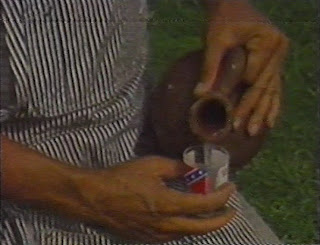
Another Saturday afternoon at Haley Barbour's house...

Soon, a gaggle of gnarly hillbillies arrive, looking to purchase some of his home brew.

"Buenos dias!"

Later that night, the moonshiner accidentally spills some of his latest batch on his hand, and is horrified to see that it nearly melts his skin! He briefly considers alerting his most recent customers, but instead dumps the booze and dismantles his still. Meanwhile, his impressively bearded customers begin melting and mutating in front of their horrified friends and families (and this was still two years before Street Trash!).

I see someone's been reading Tom Savini's Grande Illusions

They then predictably turn up at the cabin as puffy-faced zombies, out for revenge.

"Was that moonshine manufactured in an FDA-certified production facility?"


After being cornered in his cabin by the angry zombies, the moonshiner finally decides to do the only admirable thing, and swallows the rest of his tainted hooch.

"Moonshine" works much better than the first story, and has a nice (if cheap) EC Comics feel, which is what I think the director was going for. In any case, it's the highlight of the film.

Next up, our bespectacled third protagonist (Mike Gordon) gets the Preacher Hopewell treatment in "King of the Road." Gordon is first seen flying down a rural highway in clear violation of local traffic laws. He stops by a bar, where some good-looking girls and their boyfriend taunt him, then ask for a ride.

Trying to impress his carload of bimbos, our nerdy hero first drives really, really fast, then harasses a slower, elderly driver who crashes into a ditch. He then dumps his shocked passengers on the side of the road.

Our hero?

Enter a rampaging spirit of vengeance in the form of a long-haired demon (played by David Hopper, effects artist Chris Witherspoon, and Andrew Stewart) driving an old hearse with a skull strapped to the hood. The screamin' demon chases Gordon until HE crashes into a ditch.

If you're in the business of harvesting souls, always keep a bungee cord on hand

From that point forward, it's a foot race between the pudgy Gordon and his lithe, leather-clad, scythe-wielding tormentor. The two of them awkwardly gallop from a nearby Indian burial site (this is an actual historical site near West Point) and then through a junkyard, where Gordon finally meets his unpleasant end.

I foresee a future in producing music videos for local bands

Back at the church, the nervous men leave as the church organist congratulates the preacher on his sermon. As the preacher turns to leave, we get the expected ironic coda in which we discover that Preacher Hopewell was, indeed, born with a tail.

So, what do we make of Southern Shockers? While it's cautionary comic book stories are a tad predictable, the film itself boasts some decent special effects, okay lighting (always a problem with these Betacam and Super VHS movies), some interesting camera work, a decently executed car chase, and some banjo music to enliven what is otherwise a typically droning synthesizer score (to be fair, the score may have actually been dubbed in by the Spanish distributor).

In fact, while it's no classic, it's certainly on par with other contemporary SOV films from the same period, which makes it even MORE of a mystery why no one has ever heard of or seen this thing before.

We really would like to track down some of the filmmakers and find out more, so here's a more complete credits list. If you know any of these people, we'd love to hear from them.

Southern Shockers (1985)

Director: David Coleman
Producers: Mike Gordon, David Hopper
Editor: Ken Sanders
Make-up and special effects: Chris Witherspoon
Music: Ron Evans and Mike Hampton

Cast
Eric Shusterman
Mike Gordon
Robert Harrell
Tom Hatcher
Tammy King
John Sorrels
Thomas Shinn
Ken Sanders
Ronald Demerit
Don Smith
Jerry Sanders
Lyndon Love
Anna Wilson
April Fleming
Greg Jeffries
Andrew Stewart
Vicki Stevens
Greg Stroud

Friday, January 28, 2011

Mystery Film: Southern Shockers (1985)


Reader and Classic Horror Film Board member todmichel recently alerted us to a post over at the Cinehound Forum that includes a VHS box cover and screen caps from a previously unheard of omnibus flick called Southern Shockers that was filmed in West Point, Miss., in 1985.

The box in the Cinehound post appears to be from either Spain or Latin America, and presents the film as El Espiritu del Zombie (The Spirit of the Zombie), although the credits are all in English.

For you youngsters in the audience, VHS technology and the color red had an often stormy relationship...


Here's the info:

Director: David Coleman
Producer: David Hopper
Special Effects: Chris Witherspoon
Catering: Marcia Gibson
Cast: Mike Gordon, Robert Harrell, Tom Hatcher, Eric Shusterman (as Preacher Hopewell)


Oddly enough, I spent every summer during the late 1980s in West Point, Miss., and I still have family there. But I never heard of this movie, which appears to be a very cheap, shot-on-video effort. Anyone know anything about this one? If you have information, post it here in the comments section or send me an e-mail!