After many, many months of piddling around, I'm finally getting back to this blog project, and I'm now in a position to officially announce that I'm in the final stages of completing my book about regional horror films, tentatively titled -- ahem -- The Dead Next Door.
The book itself will include interviews with a number of regional horror film directors and producers, as well as what is becoming an unexpectedly voluminous compendium of all the regional horror films I could find documentation on, listed by state, from 1957 to 1990. (For more on exactly what all this means, I'll refer you to my very first posting
here.)
As for the blog you see before you, I plan to use this space to post some of the newspaper clippings, reviews, photos, advertisements and video clips I uncovered while researching the book, along with information on new regional horror film DVD releases, any new information that comes along
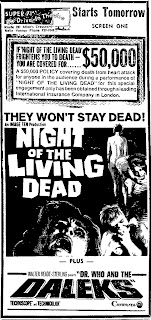
In that spirit, I'd like to kick things off (again) with some of the original reviews of what I think is arguably the single most important regional horror film of all time (and one of the most important horror films of the last 50 years), Night of the Living Dead. While George Romero's debut feature now stands as the horror flick that launched a thousand inferior zombie movies, during its 1968 debut the film was largely lambasted by critics.
Most famously, Rogert Ebert raked the film over the coals in the
Chicago Sun Times -- you can read his review
here. Note that Ebert has since amended the review with a preface explaining that rather than critiquing the film, he was actually criticizing the distributor's (or exhibitor's) admittedly idiotic decision to screen the film as a kiddie matinee. I generally side with Ebert on that one; his description of the impressionable young audience's reaction to the most nihilistic film of the decade is both horrifying and surreal.
Other critics, who evidently saw the film with adults, were even less enthusiastic about NOTLD, and could barely contain their contempt for what I'm sure they thought were a bunch of rubes from Pennsylvania. Within a year or two, a few critics (notably Pauline Kael) would give the film better notices as it became an underground hit on the Midnight movie circuit, but I find these early reviews fascinating. I especially like the apocalyptic tone of the Variety review, and Vincent Canby's sneering reference to the film being made by "some people from Pittsburgh."
From The New York Times (Vincent Canby, 12/5/1968):
"Night of the Living Dead" is a grainy little movie acted by what appear to be non-professional actors, who are besieged in a farm house by some other non-professional actors who stagger around, stiff-legged, pretending to be flesh-eating ghouls.
The dialogue and background music sound hollow, as if they had been recorded in an empty swimming pool, and the wobbly camera seems to have a fetishist's interest in hands, clutched, wrung, scratched, severed and finally -- in the ultimate assumption -- eaten like pizza.
The movie, which was made by some people in Pittsburgh, opened yesterday at the New Amsterdam Theater on 42nd Street and at other theaters around town.
And from Variety (Lee Beaupre, 10/16/1968):
Made-in-Pittsburgh horror film sets a new low in box office opportunism. Casts doubt on all concerned, including exhibs who decide to play it.
Until the Supreme Court establishes clearcut guidelines for the pornography of violence, "Night of the Living Dead" will serve nicely as an outer-limit definition by example. In a mere 90 minutes, this horror film (pun intended) casts serious aspersions on the integrity and social responsibility of its Pittsburgh-based makers, distrib Walter Reade, the film industry as a whole and exhibs who book the pic, as well as raising doubts about the future of the regional cinema movement and about the moral health of filmgoers who cheerfully opt for this unrelieved orgy of sadism.
Although pic's basic premise is repellent -- recently dead bodies are resurrected, via that old fright-film debbil radiation, and begin killing human beings in order to eat their flesh -- it is in execution that the film distastefully excels. No brutalizing stone is left unturned: crowbars gash holes in the heads of the "living dead," people are shot in the head or through the body (blood gushing from their back), bodies are burned, monsters are shown eating entrails, and -- in a climax of unparalleled nausea -- a little girl kills her mother by stabbing her a dozen times in the chest with a trowel and the remainder of the cast (living living, that is) suffer similarly disgusting fates.
While all these set-pieces are staged with zestful realism, the rest of the pic is amateurism of the first order. Director George A. Romero appears incapable of contriving a single graceful set-up, and his cast is uniformly poor. Both Judith O'Dea and Duane Jones are sufficiently talented to warrant supporting roles in a backwoods community theatre, but Russell Streiner (rollercoaster inflections), Karl Hardman (eyeballrolling and clenched fists pumping the air for emphasis), Keith Wayne (eyeblinking every other word) and Judith Ridley (pretty but catatonic) do not suggest that Pittsburgh is a haven for undiscovered thespians.
Apart from all those gory special effects and makeup, the production is even worse. Romero's photography is abysmally lit and the processing appears to have been done on 20-year-old Army stock. The music (uncredited and almost certainly canned) ludicrously hypes every gratuitous shock effect and reminds one of a late-'30s serial with its moaning and droning. Even the lip-synch was off for about 15 minutes at screening caught, and sound throughout has the echo-in-an-empty-room quality of most unprofessional low-budget (under $200,000) efforts.
John A. Russo's screenplay is a model of verbal banality and suggests a total antipathy for his characters (particularly the women, all blithering idiots), if not for all humanity. On no level is the unrelieved grossness of "Night of the Living Dead" disguised by a feeble attempt at art or significance. Pic apparently cleaned up in its first multiple break in Pittsburgh and quite possibly a sufficient market exists elsewhere.
Distrib may end up crying all the way to the bank, but what a way to make a (fast) buck!